
Best Paris Walking Routes for First-Time Visitors: A Local's Guide
Why Walking Is the Only Way to Really See Paris
There's a moment — usually somewhere around your second hour in Paris — when you realise the city doesn't reveal itself from behind a bus window. It happens in the gap between two buildings on Rue de Rivoli, where a narrow passage opens into a cobblestone courtyard with a fountain you've never seen in any guidebook. Or on the Pont des Arts at golden hour, when the light hits the Seine and the entire city seems to exhale.
Paris was built for walking. The grands boulevards were designed for promenading. The covered passages were invented for strolling in the rain. Even the way Parisians orient themselves — by arrondissement, by métro stop, by the nearest boulangerie — tells you this is a city that makes sense at street level.
If this is your first visit, resist the temptation to cram everything into a hop-on-hop-off itinerary. The best Paris experiences happen between the landmarks, in the transitions, in the neighbourhoods that don't make the top-ten lists but absolutely should.
Here are five walking routes that will show you the real Paris — the one locals actually love.
Route 1: The Classic Left Bank Loop (2–3 Hours)
Start: Saint-Michel Fountain | End: Musée d'Orsay | Distance: ~4 km
This is the route we recommend to every first-time visitor, and there's a reason it never gets old.
Begin at the Saint-Michel Fountain, that dramatic bronze-and-stone monument where Boulevard Saint-Michel meets the Seine. Resist the urge to dive straight into the Latin Quarter's busiest streets — instead, slip down Rue de la Huchette, one of the oldest streets in Paris. Yes, it's touristy. Yes, the crêpe stands are overpriced. But look up: the buildings here date to the 16th century, and if you duck into the tiny Théâtre de la Huchette, you'll find that they've been performing the same two Ionesco plays since 1957. Every single night.
From here, wind south through the Latin Quarter toward the Panthéon. The walk up Rue Soufflot is worth the slight incline — the neoclassical dome appears gradually above the rooftops, framed perfectly by the street's perspective. Inside, Foucault's Pendulum still swings, and the crypt holds everyone from Victor Hugo to Marie Curie.
Turn west toward the Jardin du Luxembourg. This isn't just a park — it's a masterclass in how Parisians use public space. Students reading on iron chairs, children sailing wooden boats in the octagonal basin, chess players in the southwest corner who've been occupying the same tables for decades. Find a chair (they're free — just grab one), sit for fifteen minutes, and let the rhythm of the park wash over you.
Exit the gardens on the north side and follow Rue de Seine through Saint-Germain-des-Prés. This is gallery country — over a dozen art galleries line this one narrow street. You don't need to buy anything (or even pretend to). Just look. The window displays alone are worth the walk.
Finish along the Seine, heading west to the Musée d'Orsay. Even if you don't go inside (though you should — the Impressionist collection is staggering), the building itself is a converted Beaux-Arts railway station that tells you everything about how Paris treats its architectural heritage.
Pro tip: Start this route before 9 AM on a weekday. The Latin Quarter is practically empty, and you'll have the Luxembourg Gardens almost to yourself.
Related tour: Classic Paris Walking Tour — our guided version of this route, with stops and stories you won't find on any map.
Route 2: The Marais to Bastille Meander (2–3 Hours)
Start: Hôtel de Ville | End: Place de la Bastille | Distance: ~3.5 km
The Marais is Paris at its most layered — medieval streets beneath Renaissance mansions beneath 21st-century concept stores. It's the kind of neighbourhood where you can buy a €300 candle and a €4 falafel on the same block, and both feel perfectly in place.
Start at the Hôtel de Ville (Paris's ornate city hall) and walk east along Rue de Rivoli until you reach Rue des Archives. Turn north and you'll immediately feel the shift — the wide boulevard narrows into streets that predate Haussmann's renovation of Paris by centuries.
Make your way to Place des Vosges, arguably the most beautiful square in Paris. Built in 1612 under Henri IV, it's a perfect symmetry of red-brick-and-stone facades, vaulted arcades, and a central garden where locals spread out on the grass with wine and cheese on warm evenings. Victor Hugo's apartment is on the southeast corner — free to visit, and the views from his drawing room window frame the square exactly as he would have seen it.
From the square, head south on Rue des Francs-Bourgeois — the Marais's main commercial artery. The name means "street of those exempt from tax," after the medieval almshouse residents who once lived here. Today it's boutiques and brunch spots, but the architecture is still spectacular. Look up: you'll see medieval timber frames, Renaissance stonework, and Art Nouveau ironwork, sometimes on the same building.
Detour south to Rue des Rosiers, the heart of the historic Jewish quarter. The debate over the best falafel (L'As du Fallafel vs. Mi-Va-Mi) has been running for decades and shows no sign of resolution. Get one from each. You're on holiday.
Continue east toward Place de la Bastille. There's nothing left of the prison (the stones were repurposed across Paris), but the Colonne de Juillet in the centre commemorates a different revolution — 1830, not 1789. The new Opéra Bastille looms on the east side, a striking glass-and-granite contrast to the Opéra Garnier across town.
Pro tip: Visit on a Sunday when many Marais shops are open (most of Paris closes on Sundays, but the Marais is the exception).
Related tour: Le Marais Walking Tour — we take you through the hidden courtyards and passages most visitors walk right past.
Route 3: Montmartre Without the Crowds (1.5–2 Hours)
Start: Abbesses Métro | End: Sacré-Cœur (or beyond) | Distance: ~2.5 km
Montmartre's reputation precedes it — and that's both the appeal and the problem. The hilltop village that nurtured Renoir, Toulouse-Lautrec, and Picasso now draws millions of visitors to the same three blocks around Place du Tertre. Here's how to see the real Montmartre.
Exit at Abbesses Métro (one of the deepest stations in Paris — take the lift unless you fancy 200+ stairs as a warm-up). The station entrance itself is one of only two original Hector Guimard Art Nouveau covers still standing. The other is at Porte Dauphine. They're national treasures, and most people walk past without a glance.
Instead of heading straight uphill, turn left on Rue des Abbesses and follow it west. This is where actual Montmartrois do their shopping — bakeries, cheese shops, a little cinema called Studio 28 that was the first purpose-built movie theatre in the world (1928). Jean Cocteau designed the sconces in the auditorium.
Work your way uphill via Rue Lepic. This winding street hosted Van Gogh's apartment (at no. 54, with his brother Theo) and leads past the Moulin de la Galette — one of only two surviving windmills in Montmartre, immortalised by Renoir in 1876.
Avoid Place du Tertre if you value your sanity (or at least pass through quickly). Instead, circle north to Rue Cortot and the Musée de Montmartre, housed in the oldest building on the hill. The garden out back has a view over the last working vineyard in Paris — they still harvest it every October, with a neighbourhood festival that's been running since 1934.
Approach Sacré-Cœur from the east side, via Rue du Chevalier de la Barre. You'll skip the crowded front steps and the persistent scam artists with their "friendship bracelets." The view from here — all of Paris spread below, the Eiffel Tower in the distance, planes glinting on approach to CDG — never gets old, no matter how many times you see it.
Pro tip: Come at sunset. The west-facing steps of Sacré-Cœur fill up fast, but the lawn just below is usually quieter and the view is just as good.
Related tour: Montmartre's Artistic Secrets: A Private Walking Tour — our guide grew up in the 18th arrondissement and knows every shortcut on the hill.
Route 4: The Seine-Side Stroll, Île to Île (1.5–2 Hours)
Start: Pont Neuf | End: Pont de Sully | Distance: ~3 km
Paris has two islands in the Seine, and they're where the city began. This route threads through both.
Start on the Pont Neuf — despite the name ("New Bridge"), it's actually the oldest standing bridge in Paris, completed in 1607. The faces carved into the cornices are some of the most expressive grotesques in the city. Walk to the western tip of the Île de la Cité, where the triangular Square du Vert-Galant dips almost to water level. In spring, the weeping willows frame a view of the Louvre that feels like a painting.
Walk east along the quays toward Notre-Dame. The cathedral's restoration continues, and watching it emerge from the scaffolding is itself a remarkable sight — a building that has survived since 1163, enduring revolutions, wars, and the 2019 fire, slowly being made whole again. The square in front is usually uncrowded on weekday mornings.
Cross the small bridge to the Île Saint-Louis. This is Paris's other island, and it feels like a village — four streets wide, no métro station, and an almost eerie calm. Walk the central Rue Saint-Louis en l'Île and stop at Berthillon (or any of the ice cream shops that claim to sell Berthillon — the original is at no. 31). The wild strawberry sorbet in late spring is transcendent.
Loop back along the south quay for views of the Left Bank, and cross at the Pont de Sully to the Jardin des Plantes neighbourhood, where the pace drops even further and the botanical garden offers one of the greenest, quietest spots in central Paris.
Pro tip: The bouquinistes (open-air booksellers) along the Seine on the Left Bank side are a UNESCO-listed tradition. Browse without pressure — the best finds are vintage postcards and old magazine covers.
Related tour: Notre Dame, Sainte-Chapelle & Conciergerie Outdoor Walking Tour — the full island-to-island experience with stories spanning 2,000 years.
Route 5: Champs-Élysées to Trocadéro, the Scenic Way (2–2.5 Hours)
Start: Concorde | End: Trocadéro | Distance: ~4.5 km
Yes, the Champs-Élysées is on this list. But we're not sending you down the main avenue.
Start at Place de la Concorde, the largest square in Paris. The 3,300-year-old Luxor Obelisk at its centre was a gift from Egypt in 1833 — the golden cap was added in 1998. The fountains, modelled on those in St. Peter's Square, are most beautiful in early morning light.
Instead of walking up the Champs-Élysées itself, enter the Jardin des Champs-Élysées on the south side. These gardens are a secret in plain sight — shaded allées, open-air restaurants, the Petit Palais (free entry, extraordinary collection), and almost no tourists. Follow the garden paths west, parallel to the avenue but a world away from the chain stores and fast-food restaurants.
Emerge near the Grand Palais (check if the current exhibition interests you) and continue west to the Arc de Triomphe. The underpass takes you safely to the centre of the roundabout, where the view down twelve radiating avenues is one of the great urban panoramas in the world. The Tomb of the Unknown Soldier beneath the arch is reignited every evening at 6:30 PM — a ceremony that has taken place every single day since 1923.
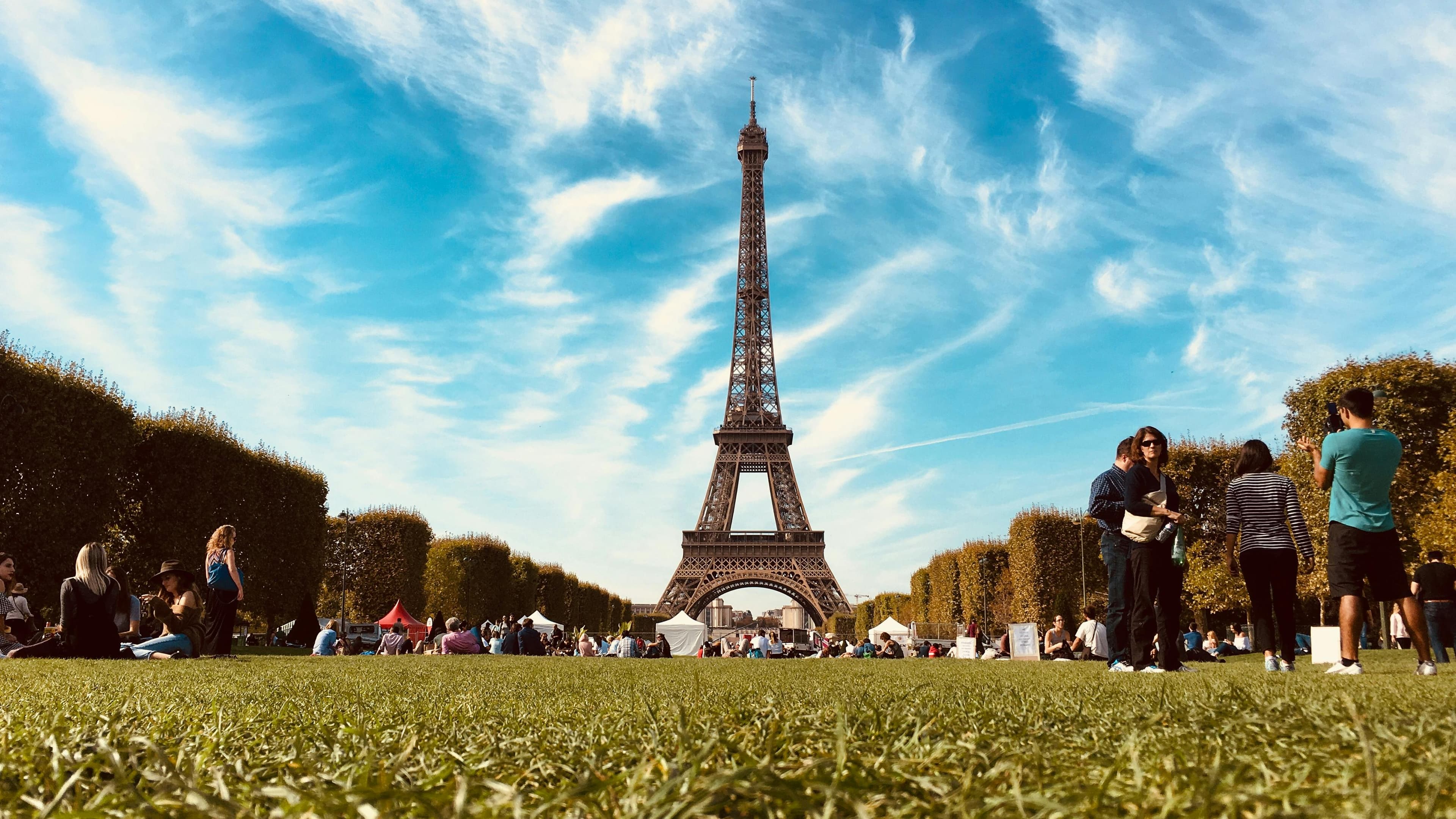
From the Arc, head southwest on Avenue Kléber toward the Trocadéro. The esplanade here offers the most famous view of the Eiffel Tower, and it earns every cliché. On clear days, the tower seems to float above the Champ de Mars. On misty mornings, it disappears into the sky above the second platform.
If time allows, descend to the Jardins du Trocadéro and cross the Pont d'Iéna to the tower itself. Even if you don't go up (queues can be brutal without pre-booking), the iron lacework seen from directly below is extraordinary engineering made beautiful.
Pro tip: The Trocadéro esplanade is packed by mid-morning. Come before 8 AM, or after sunset when the tower sparkles for five minutes on the hour.
Related tour: Eiffel Tower Dedicated Reserved Access — our most popular tour hits the highlights without the crowds.
Before You Lace Up: Practical Walking Tips
A few things worth knowing before you set off:
- Shoes matter more than you think. Paris is cobblestones, uneven kerbs, and marble museum floors. Comfortable, broken-in walking shoes are non-negotiable. Leave the new trainers at home.
- Hydrate. The city has over 1,200 free drinking fountains (look for the distinctive dark-green Wallace fountains designed in the 1870s). Download the "Eau de Paris" app to find the nearest one.
- Carry a light layer. Paris weather changes fast, especially in spring and autumn. A packable rain jacket takes up no space and saves the day at least once per trip.
- Walk on the right. Pavements, stairs, escalators — always keep right. Parisians walk with purpose and mild impatience.
- Timing is everything. Major sites are emptiest before 10 AM and after 4 PM. The city's magic hour is 7–9 PM in summer, when the light goes golden and the terraces fill up.
Your Paris, On Foot
Every one of these routes is free, self-guided, and available whenever you are. But there's something to be said for having a local Parisian walk beside you — someone who knows which courtyard doors are unlocked, which café Hemingway actually drank at (not the one that claims it), and why that particular street corner matters.
That's what we do at Scenic Zest Tours. Our small-group walking tours are led by Parisians who live in these neighbourhoods and love showing them off. No earpieces, no flags, no rushing — just a good walk with someone who knows the way.


